
BC developers leave six figures of FortisBC money inside their apartment buildings all the time. The FortisBC CNC rebate pays $2.50 per square foot of conditioned floor area on a new apartment building that declares Step 4 of the BC Energy Step Code. On a 4-storey wood-frame rental that is six figures on one building. Most of it never gets collected. Not because the buildings fail to perform. Because nobody enrolled the project before construction started. The money is already in your building. Someone just has to do the paperwork in the right order, and FortisBC is not going to chase you down the street waving a cheque. Utilities are not built that way.
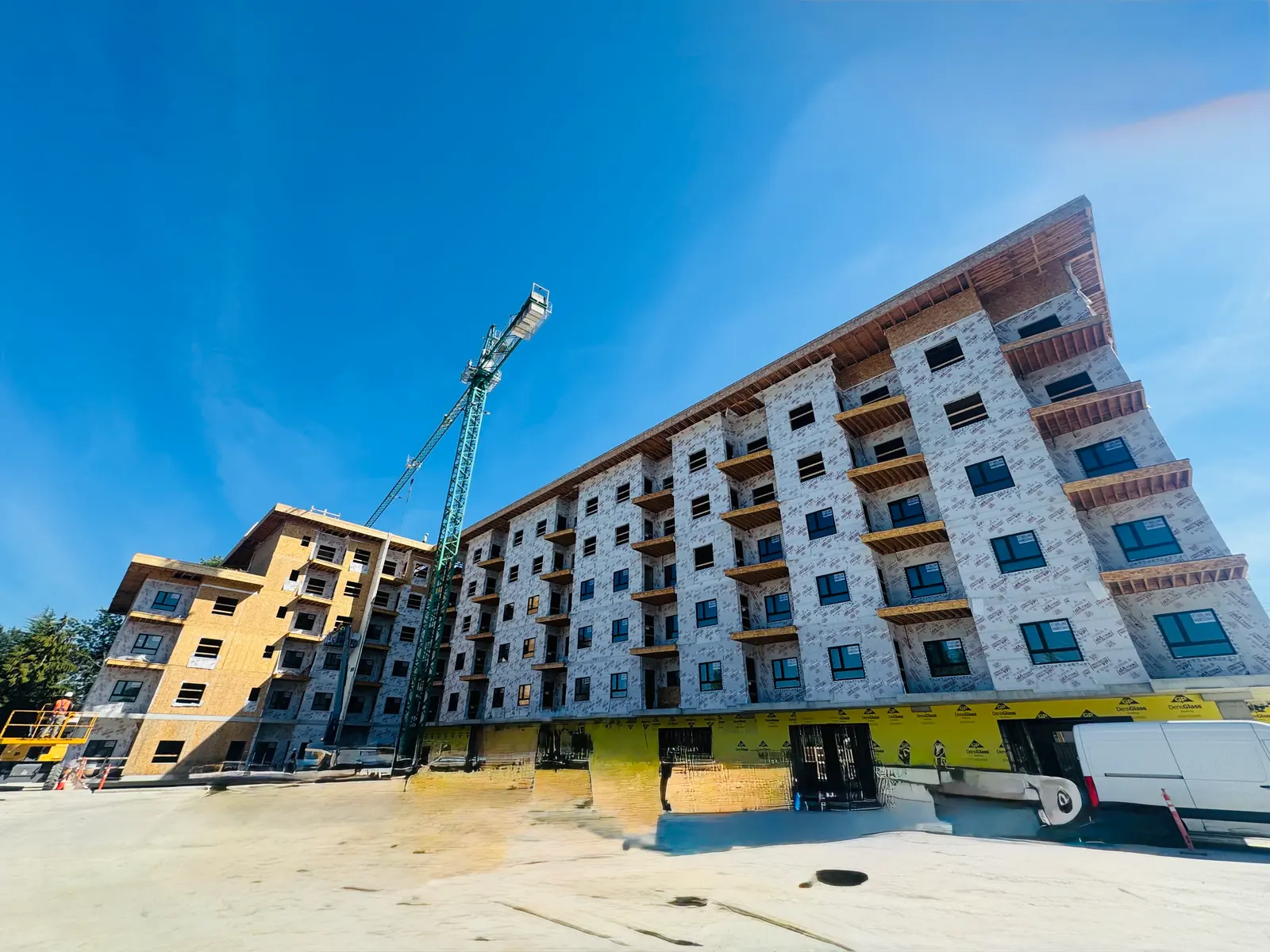
What the CNC program pays on one building
CNC stands for Commercial New Construction. It is the FortisBC program that pays developers for new multi-unit residential buildings that beat the energy code. Three cheques matter:
- A capital incentive of $2.50 per square foot of conditioned floor area, paid against a Step 4 declaration
- An energy model rebate covering 50 percent of your modelling cost, up to $15,000
- A mid-construction airtightness test rebate covering 75 percent of the test cost, up to $5,000
Run that on a real building. An 84 unit, 4-storey wood-frame rental at 62,660 square feet earns a capital incentive of $156,650. That is $1,865 per door. Not a rounding error. That is a number that changes a pro forma.
The full picture of how Step 4 fits with MLI Select financing lives in our BC Energy Step Code MURB guide, and how the financing points themselves score is covered in our CMHC MLI Select energy points guide. This post is about one thing. The sequence that gets the CNC money paid out, and the two mistakes that quietly kill it.
The catch: you enroll before you build
CNC enrollment happens at design stage. Before above-ground construction begins, the project signs a FortisBC incentive estimate letter. That letter is the ticket. No letter before construction, no rebate after it.
There is no retroactive lane. A building that pours, frames, sheets, and then applies is out, no matter how well it performs. Paperwork filed after framing is worth about as much as a lottery ticket from last week.
This is why the money gets missed. At design stage nobody owns the rebate. The architect is drawing. The mechanical engineer is sizing equipment. The energy modeller is running the permit model. Every one of them assumes someone else called FortisBC. Then the crane shows up and the window closes.
The fix costs nothing. Someone on the project has to enroll before the envelope specs lock. That is the entire trick.
Step 4 is where the money is
A Step 3 declaration earns zero dollars from the CNC capital incentive. The meaningful tier starts at Step 4. Declare Step 4 on the checklist and the $2.50 per square foot applies. Declare Step 3 and FortisBC keeps the money.
It is worth being clear about what the code actually requires, because most people have it wrong. The provincial minimum for a new apartment building is Step 2 plus Zero Carbon Energy Level 1. Step 3 is only required where a local government has adopted it by bylaw. Step 4 is voluntary almost everywhere. That is exactly why FortisBC pays for it. The program rewards performance the code does not force you to build.
On a 4-storey wood-frame rental, Step 4 is an envelope play. Airtightness carries the load, and closed-cell spray foam in the exterior walls is how our buildings get there. That work is covered in detail on our MURB building envelope page.
Here is the opinion part, backed by a number. The building industry has been slow to figure out what spray foam does at this scale. People get stuck on the price per square foot and never do the math on what the envelope earns back. A 4-storey rental we insulated posted a blower door result of 0.20 litres per second per square metre of facade. Airtightness like that on an apartment building is what makes a Step 4 declaration something you can sign with a straight face.
The make-up air trap
This is the paragraph that saves someone six figures, so read it twice.
Every apartment building has a make-up air unit, usually called the MUA. It is the machine that pushes fresh air into the corridors. To stay eligible for the CNC rebate, the MUA must be gas fired condensing equipment running at 90 percent AFUE or better. AFUE is just the share of the fuel that becomes heat.
Here is how the trap springs. Partway through design, someone proposes switching the MUA to electric. It feels like a green upgrade and it can help chase other targets. Nobody in the room connects it to the rebate. The switch goes on the mechanical schedule, and the CNC eligibility dies right there. Same result with a cheaper non-condensing gas unit at around 80 percent AFUE. Either way, one line item just torched the biggest rebate on the project.
Nobody loses $156,650 on purpose. It happens one revision at a time, in a meeting about something else.

The building that left $161,650 behind
At a pre-construction review of a 4-storey rental building in the Okanagan Valley, we found $161,650 in FortisBC rebates sitting unclaimed. The performance was there. The energy numbers came in at 94 kilowatt hours per square metre per year against a Step 3 target of 119, which beats the target by 21 percent.
The gap was pure process. The project was never enrolled before construction, and the declaration was signed at Step 3. The capital incentive alone was $156,650. Add the rest of the stack and $161,650 stayed with FortisBC. The building did its job. The paperwork did not.
That finding is the reason this post exists. Six figures did not vanish in a market downturn or a bad trade. It vanished in the gap between a strong building and an unsigned form.
The exact sequence to capture it
Four gates, in order. Miss one and the money stays with the utility.
- Enroll before above-ground construction. Contact the CNC program at design stage and get the incentive estimate letter signed before the building comes out of the ground.
- Declare Step 4 on the checklist. The BC Step Code Appendix B checklist, Section C. Step 4, not Step 3. This is a box on a form and it is worth $2.50 per square foot.
- Pass the mid-construction gate. Above-ground construction attestation plus a site report. Do the mid-construction airtightness test here. FortisBC pays 75 percent of it, which is a rare case of getting paid to check your own work.
- Finish as modelled. Final inspection, with every energy measure installed exactly the way the energy model assumed. If the model says condensing MUA and 5 inches of foam, that is what the inspector needs to find.
The envelope contractor matters at gates three and four, because a blown schedule or a changed spec breaks the chain. Out of every trade on our commercial jobs, one thing gets said about our crew consistently. Nobody ever has to worry about us. We have never been the reason a building fell behind schedule, and a rebate that depends on sequence is a bad place to test that. That reliability is a big part of what our commercial spray foam insulation work is built on.
Where CNC applies, and when to skip it
The program needs gas service for the primary heating equipment, so it only exists where local rules allow gas. In the BC Interior that covers Vernon, Kelowna, Salmon Arm, and Kamloops, which all sit at the baseline Zero Carbon Energy Level 1.
Municipalities that have adopted Energy Level 3 or 4 require electric primary heating, which removes the gas equipment CNC pays against. If you are building in one of those cities, or your building is all electric by choice, this is not your program and we will not pretend otherwise. There is no rebate to capture, so do not pay anyone to capture it. The envelope argument on those buildings is a different conversation about airtightness and passing code the first time.
Everyone else is probably leaving money on the table.
Get the review before the specs lock
The whole game is timing. Once the envelope specs lock and the crane shows up, every dollar above is gone, and no amount of good performance brings it back.
So here is the ask. Book a free building assessment for your next project. For developers this is a pre-construction rebate and compliance review. We go through the drawings, the energy model path, the mechanical schedule, and the rebate stack, and we put in writing what the building can earn and what would disqualify it. If the honest answer is that there is nothing there, you will hear that too, and it will have cost you an hour.
Book a free building assessment before your envelope specs lock. The money is already in the building. Go get it.
Sources
- FortisBC Commercial New Construction Program: fortisbc.com
- FortisBC CNC Participant Guide, July 2025: fortisbc.com
- BC Energy Step Code, Part 3 checklist: bcenergystepcode.ca